











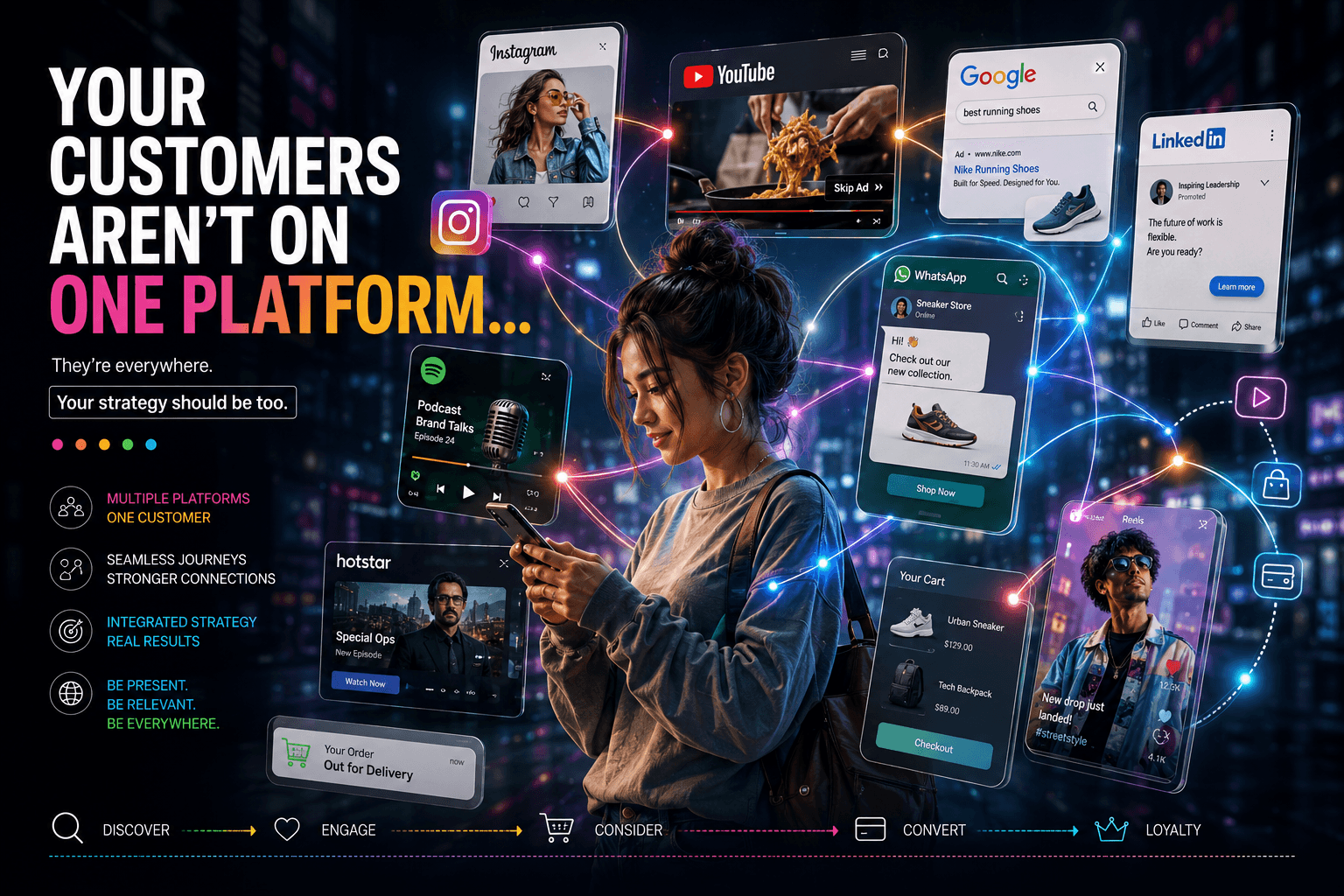
Most media plans are built as a set of separate bets. A budget for search, a budget for social, a budget for video — each measured on its own, each defending its own line. It is tidy. It is also wrong, because no customer experiences your brand one channel at a time.
A real customer journey is messy and cross-platform. Someone sees a video, forgets it, searches a week later, reads a review, sees a retargeting ad, and finally buys at a point of sale that gets none of the credit in a siloed model. If your channels are planned as competitors, you are optimising each one to look good in isolation while the actual journey leaks customers at every handoff.
When we launched Hindustan Unilever's first heritage-tea D2C venture, the win was not any single channel — it was the connections between them. Programmatic fed retargeting. Retargeting recovered abandoned carts. Email segmented new, returning, and churned buyers differently. The result was orders sustained above 1,000 a month, average order value doubled, and the return ratio halved from 20% to 10% — none of which came from one heroic channel, and all of which came from the handoffs working.
The shift is to stop planning channels and start planning the journey between them. Ask of every channel: what is it handing off to next, and is that handoff clean? The brands that win are not the ones with the biggest budget in any single platform. They are the ones whose platforms actually talk to each other.